
Airline security and corporate investigations
Airline security and internal investigations.
AISIS and VASIS support trained examiners conducting structured interviews involving cargo, access, personnel, and security incidents.
Request presentation access- Examiner-led
- Trained professionals direct the interview, interpret observations, and remain responsible for conclusions.
- Portable
- Microphone-based acquisition for suitable security offices, airline facilities, or authorised field locations.
- Evidence-led
- Follow-up topics are checked against records, statements, and independent evidence.
Operational applications
When an airline security issue needs a clearer account.
Scope of application: This page applies only to international carriers based outside the United States. It does not apply to U.S.-based carriers, including those operating international routes.
A cargo discrepancy, an unexplained access event, or a reported security breach may span several teams and handovers. Employees, contractors, ground handlers, couriers, and service providers may each hold a different part of the record. Investigators need to establish who observed what, which procedures applied, and where additional evidence is needed.
AISIS gives airline security and corporate investigation teams an additional source of structured information during suitable investigative interviews. Its purpose is to support focused clarification, not to turn a voice indication into an allegation.
Potential interview topics
- Cargo, baggage, stores, or high-value shipment losses and unexplained handling discrepancies
- Access-pass misuse, unauthorised entry, or unexplained movement in controlled areas
- Suspected internal collusion, theft, diversion, or misuse of entrusted responsibilities
- Security-procedure breaches involving airline personnel, contractors, or service providers
- Conflicting accounts of a handover, custody transfer, or reported security incident
- Post-incident clarification where authorised investigators have specific issues to resolve
A disciplined investigative process
Prepare. Review. Corroborate.
Before an examination, define the event, the relevant time period, and the interviewee's role. Review available cargo records, access logs, incident reports, surveillance, or statements before formulating clear, issue-specific questions.
AISIS presents stress-related vocal information for the trained examiner to consider alongside the question, the complete response, recording conditions, and interview context. The examiner decides what merits clarification and documents the limits of the observation.
Any resulting lead must be tested independently. A reported exception to a handover procedure, for example, should be checked against the applicable records and other accounts. Neither a stress indication nor an apparently calm response resolves the underlying event.
- PrepareIdentify the issue, review authorised records, and establish suitable interview conditions.
- ReviewConsider vocal observations in context, with the full interview and examiner notes.
- CorroborateVerify leads through independent records and evidence before reaching a conclusion.
From an incident to a testable lead
Focus on the gap between accounts and records.
For a cargo-handling discrepancy, an investigator may need to clarify which person accepted responsibility at a transfer point. Prepare the interview around the documented movement and the person's direct knowledge. A follow-up account of an unrecorded handover should lead to a check of transfer acknowledgements, available surveillance, and other relevant statements.
For an access irregularity, establish the assigned duty, the reported reason for entry, and any authorised exception. Ask clear questions about the specific event rather than treating a person's access privileges as evidence of misconduct. Compare the explanation with access records and the applicable procedure before deciding what the event means.
For conflicting incident accounts, separate what each person saw from what they heard later. Preserve the order of events and identify where recollection differs. The useful outcome is a specific verification task, such as checking a time, location, or responsibility, rather than labelling one interviewee as deceptive.
These are illustrative investigative applications, not reports of an airline deployment or a validated examination script. Formal examination procedures and question formulation remain the responsibility of trained examiners.
Two products. Examiner-led investigation.
AISIS innovation. VASIS experience.
AISIS is VIPRE's AI-assisted system for reviewing stress-related vocal information during investigative interviews. It supports trained examiners in identifying responses that warrant clarification and independent follow-up.
VASIS remains an active VIPRE product, with more than 20 years of operational use by trained investigative professionals. Its established voice stress technology provides an examiner-led option alongside AISIS.
Both products support professional judgment. Neither voice stress indicators nor software output independently establish deception or guilt. Review the two systems with VIPRE in the context of your team's responsibilities, training, and examination procedures.
AISIS in practice
Interview support without physical attachments.
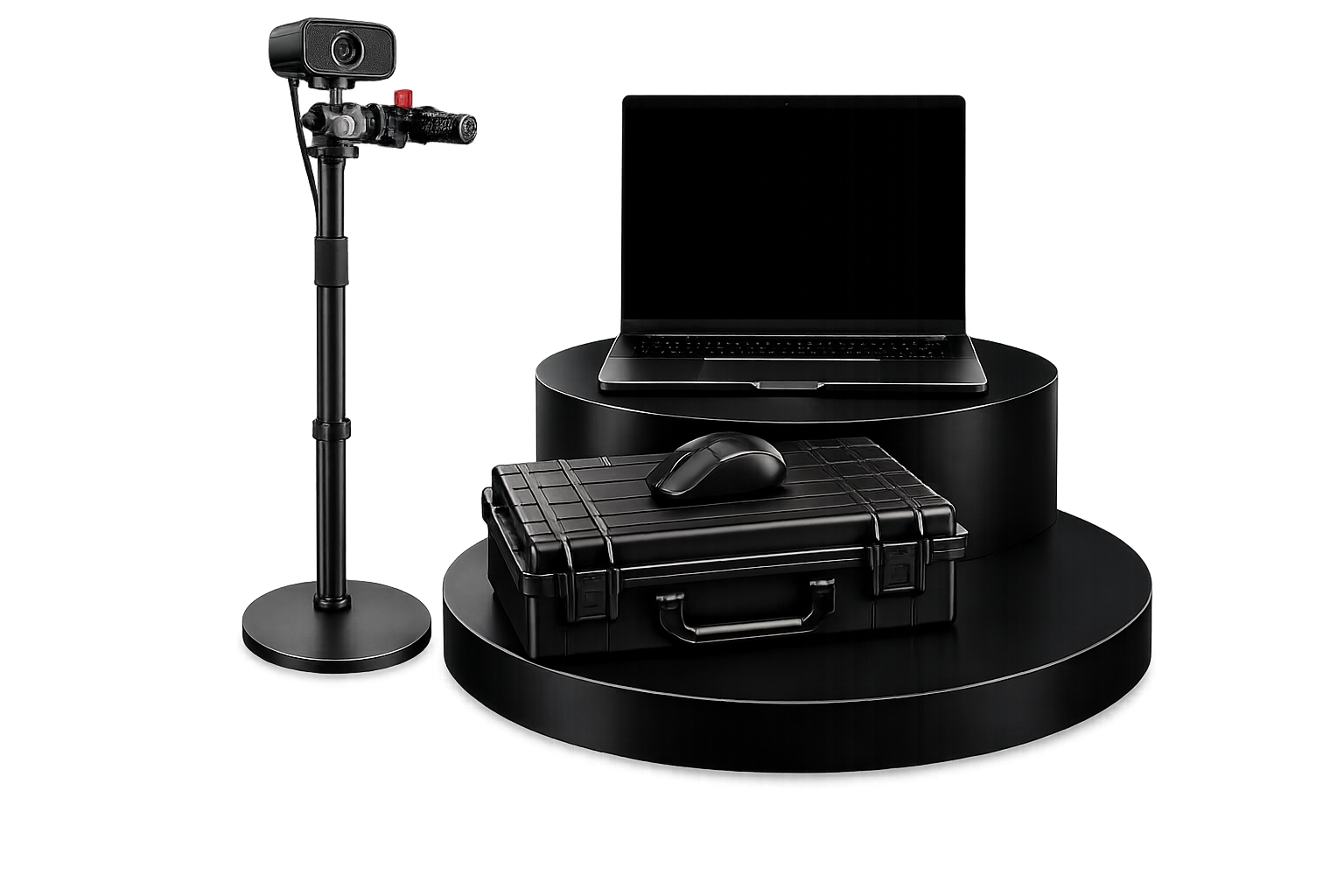
AISIS uses microphone-based voice acquisition without attaching sensors, wires, or cuffs to the person being interviewed. Its portable configuration supports suitable investigative work at a security office, airline facility, or other authorised location.
Portability does not remove the need for a controlled setting. Background noise, interruptions, language requirements, microphone placement, and recording quality should be considered before proceeding. An examiner should document unsuitable conditions rather than treat every recording as equally useful.
The AISIS platform overview explains the system, while examiner responsibility remains central to every application. AI assistance supports the professional's review. It does not independently decide whether an account is accurate.
Responsible use
One part of the investigation, never a security clearance.
AISIS is an investigative aid. Voice stress indicators do not, by themselves, establish deception or guilt. Anxiety, the significance of a question, interview conditions, and other contextual factors can influence a response. The examiner must keep alternative explanations open.
It is not a replacement for aviation security controls, mandatory checks, or established incident-response procedures. It should not be used as an automatic hiring, access, disciplinary, or operational fitness decision. It does not provide a medical or psychological diagnosis.
Before introducing an examination process, the airline should establish its authorised use, applicable requirements, appropriate participation procedures, recording arrangements, and handling of interview information. Security, human resources, and qualified advisers should define responsibilities for review and follow-up.
Reports should distinguish the interviewee's account, the examiner's observations, and independently verified facts. A follow-up topic that cannot be corroborated remains unresolved. Clear documentation helps supervisors assess the investigation without treating the software output as a verdict.
Qualified deployment
40-hour basic examiner certification.
VIPRE provides basic examiner certification covering system operation, examination procedures, question formulation, chart evaluation, and examiner responsibilities. Online training is available, with operational support for qualified users.
Discuss who will conduct examinations, who will review the records, and which interview settings are suitable before deployment. Training should support a repeatable process, from preparation and question design through documentation and independent follow-up.
AISIS builds on more than two decades of VIPRE VASIS voice-stress experience while keeping trained examiners in control.
Questions from airline security teams.
Can AISIS establish deception or guilt?
No. Voice stress indications do not independently establish truthfulness, deception, or guilt. They may identify a topic requiring clarification. Investigative conclusions must be supported by the full interview, independent evidence, and other relevant information.
Does AISIS replace aviation security screening or background checks?
No. AISIS is an interview-support tool for trained examiners. It does not replace passenger or baggage screening, access controls, background checks, physical security measures, or any required aviation security procedure. It is not a pilot fitness or medical assessment.
Does the person being interviewed wear sensors?
No. AISIS acquires voice information through a microphone without attaching physical sensors, wires, or cuffs to the person being interviewed. A suitable recording environment and trained examiner remain essential.
How can our team review the software package?
Use the request form to ask for a link and password access to the online AISIS informational presentation. Requests are reviewed by VIPRE. A separate VASIS informational video is also available on request.
Online software presentation
Request software presentation access.
Request a link and password access to VIPRE's online AISIS informational video. Use the questions field to describe the investigative applications your team would like to review.
A separate VASIS informational video is available for those who would like to review the technology and experience behind AISIS.
VIPRE reviews each access request. Submitting the form does not automatically provide access.